When your sewer line fails in the Puget Sound region, you face a critical decision that could save you thousands of dollars and weeks of disruption. Modern trenchless technology has transformed sewer line replacement, offering homeowners in Kent, Everett, and Bellevue a revolutionary alternative to the destructive excavation methods of the past.
At Pike Plumbing & Sewer, we’ve completed over 5,000 projects across King, Pierce, and Snohomish Counties, witnessing firsthand how trenchless methods have revolutionized our industry. What once required destroying driveways, landscaping, and sidewalks can now be accomplished with minimal surface disruption.
85% of our sewer replacements now use trenchless methods
Trenchless Sewer Line in Kent
Kent homeowners have unique advantages when considering trenchless sewer line replacement. The city’s mature neighborhoods, established in the 1960s and 1970s, often feature aging cast iron and clay pipes that are prime candidates for trenchless repair methods.
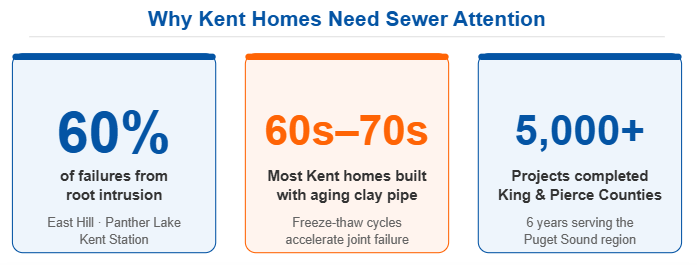
Our Kent location at 26530 Woodland Way S has served the community for six years, and we’ve observed specific patterns in local sewer line failures. Kent’s clay-heavy soil composition, combined with the region’s frequent freeze-thaw cycles, creates ideal conditions for pipe joint separation and root intrusion.
“We needed a full replumb of our entire townhome. Pike Plumbing gave me a bid that was $10,000 less than big corporate, and it included everything the other bid missed.” — Bill Ryan, Kent homeowner
The neighborhoods around Kent Station, East Hill, and the Panther Lake area frequently require sewer line attention due to their mature tree canopies. Root intrusion affects 60% of sewer line failures we encounter in these established Kent neighborhoods.
Trenchless Sewer Line Replacement: Why It’s Better Than Traditional Excavation
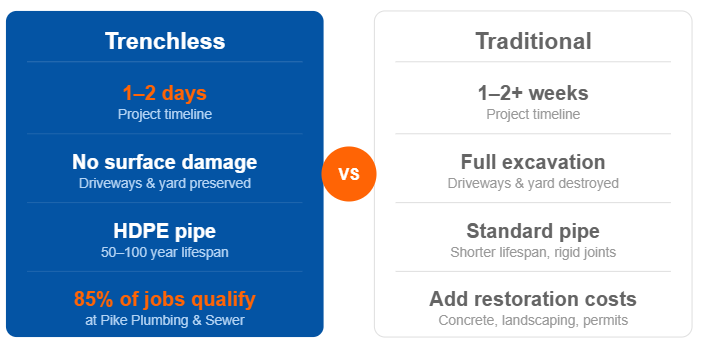
The fundamental difference lies in access methodology. Traditional excavation requires digging a continuous trench from your home to the street connection point. Trenchless replacement accesses your sewer line through strategic entry and exit points, leaving everything in between undisturbed.
Consider the typical Kent property: mature landscaping, concrete driveways, established walkways, and often underground sprinkler systems. Traditional excavation would destroy these features, requiring complete restoration after pipe installation.
Key Takeaway
Trenchless replacement preserves your property’s surface features while delivering superior pipe materials and installation precision.
Our team has replaced sewer lines beneath driveways, sidewalks, patios, and even swimming pools without disturbing the surface. The technology allows us to install new pipe materials while simultaneously removing the old pipe.
Cost Comparison: Trenchless vs Traditional Methods
Initial cost comparisons often favor traditional excavation, but this perspective ignores restoration expenses:
- Concrete restoration — driveways, walkways, patios
- Landscaping replacement — grass, plants, irrigation repair
- Surface preparation — grading, soil compaction
- Permit costs — often higher for extensive excavation
- Temporary inconvenience costs — alternative parking, pathway access
Understanding Traditional Excavation Methods
Traditional sewer line replacement involves continuous trenching from your home’s sewer connection to the street tie-in point. This method dominated the plumbing industry for decades and remains necessary in specific situations.
The process begins with utility location services marking underground gas, electric, water, and cable lines. Excavation crews then dig a trench typically 4-6 feet deep and 2-3 feet wide, following the existing sewer line path.
When Traditional Excavation Makes Sense
Despite trenchless advantages, certain conditions favor traditional excavation:
- Severely collapsed pipes — complete structural failure prevents trenchless equipment passage
- Significant grade changes — steep slopes or elevation differences complicate trenchless installation
- Multiple connection points — complex pipe configurations with numerous branches
- Pipe material incompatibility — certain older materials don’t support trenchless removal
- Access limitations — insufficient space for trenchless equipment setup
Our Kent team evaluates each property individually. Anthony and Corey, our lead plumbers, conduct thorough camera inspections before recommending the optimal approach.
Traditional Excavation Timeline and Disruption
Traditional sewer line replacement timeline includes:
- Utility marking, permit acquisition, excavation begins
- Trenching completion, old pipe removal, new pipe installation
- Backfilling, compaction, surface preparation
- Concrete restoration, landscaping replacement
Property access remains compromised throughout this period. Driveways become unusable, landscaping suffers damage, and noise disruption affects daily routines.
Trenchless Technology Explained
Trenchless sewer line replacement employs two primary methods: pipe bursting and pipe lining. Both techniques minimize surface disruption while delivering superior results.
Pipe bursting involves pulling a new pipe through the existing line while simultaneously fracturing the old pipe outward. The fractured material remains in place, eliminating removal and disposal concerns.
Pipe lining creates a new pipe within the existing structure using epoxy-saturated materials that cure in place, forming a seamless interior surface.
Pike Plumbing’s Trenchless Process
Our trenchless methodology reflects years of refinement serving the Puget Sound region:
Our 4-Step Process
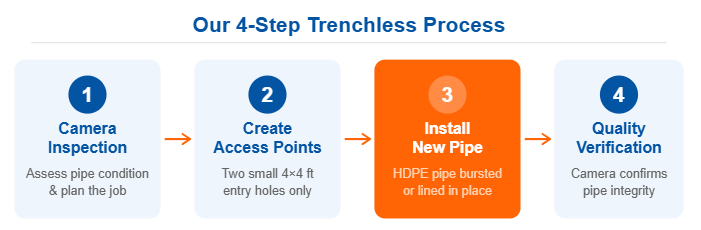
Camera inspection → Access point creation → New pipe installation → Quality verification
We begin every project with comprehensive camera inspection, documenting pipe condition, material type, and potential obstacles. This footage guides our equipment selection and installation strategy.
Access points typically measure 4×4 feet, strategically positioned to minimize landscape impact. Our equipment operates from these small work areas, avoiding the extensive trenching traditional methods require.
Material Advantages in Trenchless Installation
Trenchless methods accommodate advanced pipe materials unavailable during traditional excavation. High-density polyethylene (HDPE) pipes offer superior durability, flexibility, and joint integrity compared to traditional PVC or clay materials.
HDPE pipes resist root intrusion, chemical corrosion, and ground movement. The material’s flexibility accommodates soil settling without joint separation, a common failure point in rigid pipe systems.
“The customer service was outstanding. They went out of their way to get someone out to my house as quickly as possible. The quote was $2000 lower than the other two companies.” — Melissa Burns, satisfied customer
Cost Analysis: Total Project Investment
Accurate cost comparison requires examining total project investment, not just initial installation expenses. Our pricing transparency helps Kent homeowners make informed decisions.
Time Investment and Property Disruption
Project timeline significantly impacts homeowner convenience and property usability. Our Kent customers consistently prioritize minimal disruption when selecting replacement methods.
Traditional Timeline Challenges
Traditional excavation creates extended disruption periods:
- Excavation, pipe installation, initial backfilling
- Concrete restoration, curing time
- Landscaping replacement, irrigation repair
- Grass establishment, final cleanup
Property access remains limited throughout this period. Parking, walkway access, and yard usage face significant restrictions.
Trenchless Efficiency Timeline
Trenchless projects compress disruption into minimal timeframes:
- Site preparation, access point creation
- Pipe installation, equipment removal
- Access point restoration, final cleanup
Most property features remain accessible throughout the project. Normal routines continue with minimal interruption.
Environmental Impact Considerations
Environmental responsibility increasingly influences homeowner decisions. Trenchless methods offer significant environmental advantages over traditional excavation.
Soil and Landscape Preservation
Traditional excavation removes and displaces substantial soil volumes. A typical 100-foot sewer line replacement requires excavating approximately 800 cubic feet of soil, equivalent to 30 tons of material.
This soil displacement disrupts established ecosystems, destroys beneficial microorganisms, and often requires importing new soil for backfilling. Trenchless methods preserve existing soil structure and ecosystem balance.
Mature trees near sewer lines face particular risk during traditional excavation. Root system damage during trenching can compromise tree health for years following installation.
Waste Reduction and Material Efficiency
Trenchless installation generates minimal waste compared to traditional methods. Old pipe materials remain in place, eliminating disposal requirements and transportation emissions.
Traditional excavation creates multiple waste streams: removed pipe materials, excess soil, damaged concrete, and destroyed landscaping materials. These materials require hauling, processing, and disposal.
Technology and Equipment Advantages
Modern trenchless equipment delivers precision impossible with traditional excavation methods. Our investment in advanced technology directly benefits Kent homeowners through superior installation quality.
Precision Installation Capabilities
Trenchless equipment operates with GPS guidance and laser leveling systems, ensuring precise pipe alignment and grade. Traditional excavation relies on manual measurement and visual alignment, introducing potential errors.
Pipe joints in trenchless installations achieve superior integrity through controlled fusion welding or mechanical coupling systems. These connections exceed traditional glued joint strength and durability.
Quality Verification Systems
Trenchless and traditional projects include comprehensive quality verification through post-installation camera inspection. We document complete pipe integrity, joint quality, and alignment accuracy.
Local Considerations for Kent Properties
Kent’s specific geographic and regulatory environment influences sewer line replacement decisions. Our local expertise helps navigate these considerations effectively.
Soil Conditions and Challenges
Kent’s clay-heavy soil composition creates unique challenges for both replacement methods. Clay soil expands and contracts significantly with moisture changes, stressing rigid pipe systems.
Traditional excavation in clay soil may require extensive dewatering and soil stabilization. Clay’s poor drainage characteristics complicate backfilling and compaction processes.
Trenchless methods excel in clay soil conditions because flexible pipe materials accommodate soil movement without joint failure.
Municipal Requirements and Permits
Kent’s municipal code favors trenchless methods for several reasons:
- Reduced traffic impact — minimal street disruption
- Infrastructure preservation — sidewalks and utilities remain undisturbed
- Faster project completion — reduced permit oversight requirements
- Environmental compliance — minimal soil displacement and waste generation
Sewer Line Replacement Near You
Pike Plumbing & Sewer serves the entire Puget Sound region from our Kent and Granite Falls locations. Our service area includes King, Pierce, and Snohomish Counties, with particular expertise in Kent, Everett, and Bellevue neighborhoods.
Service Areas and Local Expertise
Each community we serve presents unique characteristics affecting sewer line replacement decisions:
- Kent: Mature neighborhoods with aging infrastructure, clay soil conditions
- Everett: Mixed residential and commercial areas, varied soil compositions
- Bellevue: Established communities with premium landscaping preservation needs
- Granite Falls: Rural properties with longer sewer line runs, access challenges
Our technicians understand local building codes, soil conditions, and municipal requirements across all service areas.
Why Choose Pike Plumbing for Trenchless Services
Our six years serving the Puget Sound region have established Pike Plumbing as the trusted choice for trenchless sewer line replacement. Anthony and Corey’s tradesman backgrounds, combined with Amy’s operations management expertise and Rachel’s business leadership, create a comprehensive service experience.
“We have had the pleasure of knowing Anthony for the past five years. His expertise shines through in every project he undertakes, ensuring that the work is done with the utmost quality.” — Linda Letney, long-term client
Our certification PIKEPPS782P7 and Chamber of Commerce membership demonstrate our commitment to professional excellence and community involvement.
Pike Plumbing Advantages
Local expertise, advanced equipment, transparent pricing, and comprehensive warranties on all trenchless installations.
Making the Right Choice for Your Property
Selecting between trenchless and traditional sewer line replacement requires evaluating multiple factors specific to your Kent property. Our assessment process helps homeowners make informed decisions based on actual conditions rather than assumptions.
Property Assessment Factors
We evaluate several key factors during our initial consultation:
- Existing pipe condition — structural integrity, material type, age
- Soil conditions — drainage, stability, composition
- Surface features — driveways, landscaping, hardscaping
- Access requirements — equipment positioning, workspace availability
- Municipal considerations — permit requirements, code compliance
Our camera inspection provides definitive information about pipe condition and replacement feasibility. This diagnostic step eliminates guesswork and ensures appropriate method selection.
Long-term Value Considerations
Trenchless replacement delivers superior long-term value through multiple factors:
- Extended pipe life — HDPE materials last 50-100 years
- Reduced maintenance — seamless joints resist root intrusion
- Property value preservation — landscaping and hardscaping remain intact
- Warranty protection — comprehensive coverage on materials and installation
Frequently Asked Questions About Sewer Line Replacement
How do I know if my sewer line needs replacement?
Common indicators include recurring drain backups, sewage odors in your yard, unusually lush grass patches above the sewer line, and multiple drain clogs throughout your home. Our camera inspection service provides a definitive assessment of pipe condition.
Can all sewer lines be replaced using trenchless methods?
Approximately 85% of sewer lines qualify for trenchless replacement. Severely collapsed pipes, extreme grade changes, or complex pipe configurations may require traditional excavation. Our initial assessment determines the best approach for your specific situation.
How long do trenchless pipe installations last?
HDPE pipes installed through trenchless methods typically last 50-100 years. The seamless joints and flexible material resist common failure modes like root intrusion and ground movement that affect traditional pipe systems.
Will trenchless replacement work in clay soil?
Trenchless methods actually perform better in clay soil than traditional excavation. The flexible pipe materials accommodate clay’s expansion and contraction cycles without joint separation, a common problem with rigid pipe systems.
What permits are required for sewer line replacement in Kent?
Both methods require municipal permits. We handle all permit applications and inspections as part of our comprehensive service.
When your Kent home needs sewer line replacement, the choice between trenchless and traditional methods significantly impacts your budget, timeline, and property preservation. Our expertise serving the Puget Sound region for six years has proven trenchless technology delivers superior results with minimal disruption.
Pike Plumbing & Sewer combines local expertise with advanced trenchless technology to provide Kent homeowners with efficient, cost-effective sewer line replacement solutions. Contact us today for a comprehensive assessment of your sewer line needs and discover why trenchless replacement might be the perfect solution for your property.